~#+TITLE: Lecture Notes for cs480
Lecture
Exam recap
finding candidate keys
-
super key \(A\): set of attributes that uniquely identifies the rows in the table
- \(A \rightarrow R\) where \(R\) are all the attributes of the table
-
candidate: (minimal) set of attributes that uniquely identifies rows in a table
- a minimal superkey
R(a,b,c)- \(\Sigma = \{ a \rightarrow b, b \rightarrow c \}\)
- Attribute closure of \(\alpha\), \(\alpha^+\) is the attribute closure
- \(A^{+} = R\) then \(A\) is a superkey
- look for attributes that do not appear in the RHS -> they have to be part of every candidate key
example computing attribute closure
- initialize \(a^+ = a\)
-
fix point computation
- if we have LHS of \(\sigma\) in \(a^+\) then add RHS
- we have
aaddb: \(a^+ = ab\) - we have
baddc: \(a^+ = abc\)
computing a canonical cover
- look at slides for tests of extraneousness
3NF + BCNF decomposition example
3NF decomposition
R(a,b,c)- \(\Sigma = \{ a \rightarrow b, b \rightarrow c \}\) is a canonical cover already
R1(a,b),R2(b,c)- we already have a candidate key! We are good
- no contained fragments -> we are done
contained fragments example
R1(a,b,c),R2(b,c),R3(c,d,e)- delete
R2because it is contained
harder relational algebra examples
Lecture
- disk-resident index structures (B-trees in depth)
- postgres internals and query plan demo
- vector databases (RAG)
- query processing on modern hardware
- more details on query optimization
- data provenance (tracking where data is coming from)
Lecture
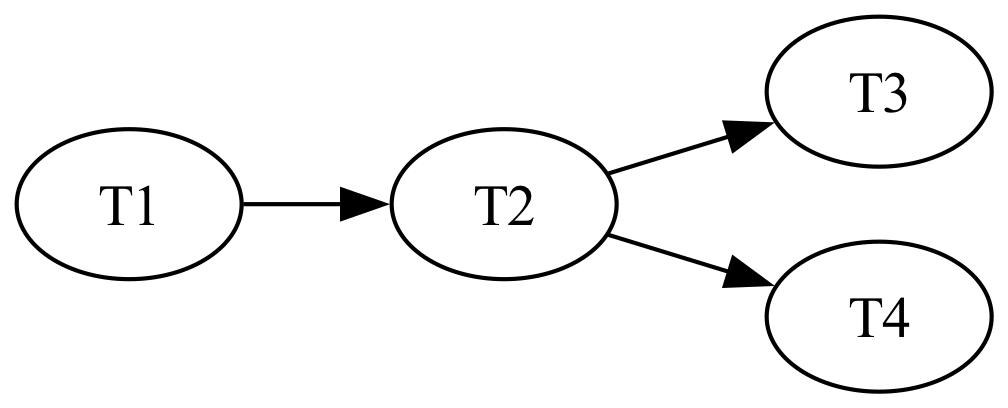
\[ S = w_1(A), r_1(B), r_2(C), w_2(B), r_3(B), w_4(C) \]
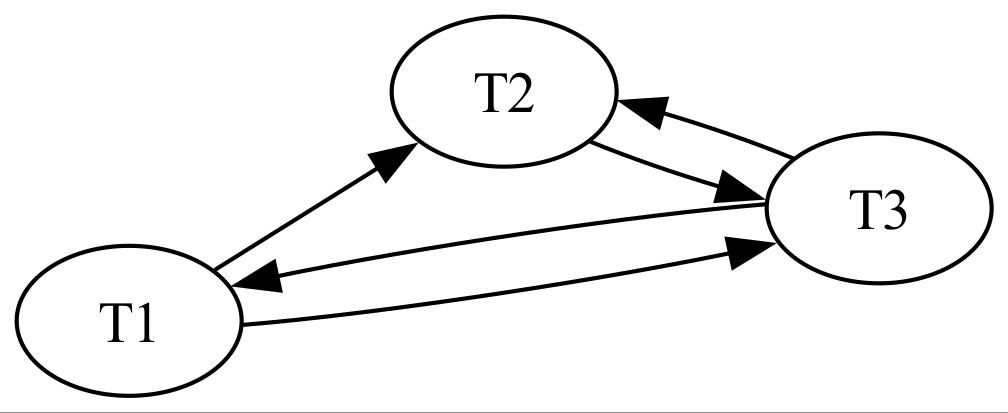
\[ S_2 = r_1(X), w_1(X), r_2(X), w_2(X), w_3(X), w_3(Y),r_1(Y), w_1(Y), r_2(Y), w_2(Y) \]
Lecture
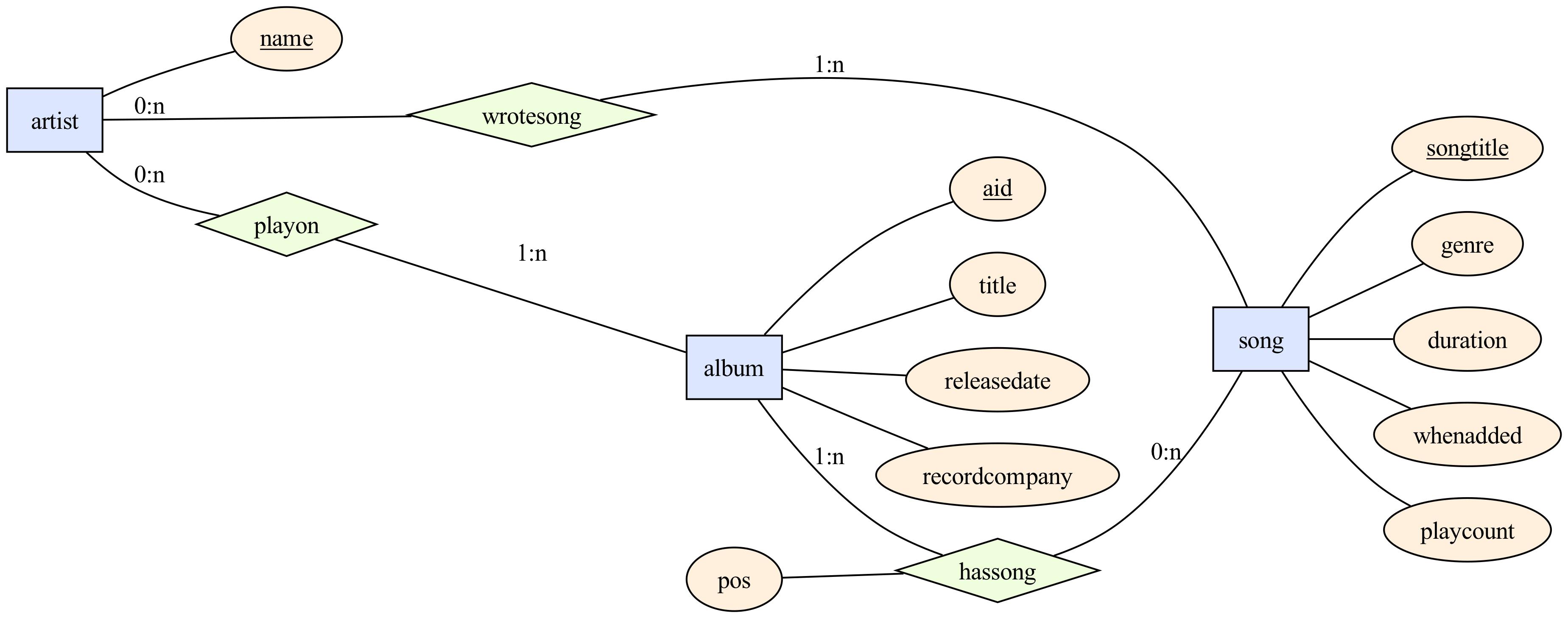
Requirements - Music collection
-
albums
- title
- which songs are on the album (and in which order)
- total length
- release date
- record company
- which artists are on the album
-
artists
- name
- album count
-
song
- title
- genre
- duration
- artist (who wrote it)
- when added
- streamcount (play count)
ER Model
music collection
Lecture
Exam recap
- relational basics
- SQL - using CTE example
- 2025 spring midterm - question 1.3.1
CTES
|
|
| headcnt | dept_name |
|---|---|
| 4 |
|
|
| headcnt | dept_name |
|---|---|
| 4 |
- substitution (only true if no side effects)
|
|
| headcnt | dept_name |
|---|---|
| 4 |
- oil on route to Amsterdam
|
|
|
|
midterm 2025 - DDL question 1.2.1
|
|
|
|
|
|
midterm 2025 - Q1.1.1 (relational algebra)
\[ \pi_{destination,item}(\sigma_{(source = Amsterdam \lor source = New York) \land (item = oil \lor item = coal) \land (quantity > 200}(cargo)) \]
Lecture
Example for triggers: track outdated row versions in a history table
- design: keep all row versions (current and old ones) in a
inventory_histtable. Uset_end = NULLto encode that a row is currently valid. Use triggers to automatically maintaininventory_hist.
the basic table (inventory of a company)
|
|
| CREATE TABLE |
the history table for old row versions
- for each old row version we track from when to when (a time interval
[t_start,t_end)is was valid)
|
|
| CREATE TABLE |
dealing with inserts
- on insert, insert tuple with
[now,NULL]intoinventory_histtable (let insert toinventoryproceed)
|
|
| CREATE FUNCTION |
|
|
| CREATE TRIGGER |
dealing with deletes
- on delete, we know that the previous row version is already in the
inventory_histtable, we just have to set its end timestamp
|
|
| CREATE FUNCTION |
|
|
| CREATE TRIGGER |
dealing with updates
- update the end timestamp of the current row version and insert the new row version with
[now,NULL]
|
|
| CREATE FUNCTION |
|
|
| CREATE TRIGGER |
COMMENT try out the history triggers
- clean the history and table
|
|
| DELETE 3 | ||||
|---|---|---|---|---|
| DELETE 3 | ||||
| t_start | t_end | itemid | itemname | quantity |
|
|
| INSERT 0 3 |
|
|
| t_start | t_end | itemid | itemname | quantity |
|---|---|---|---|---|
| 2026-03-04 13:31:36.498399 | 1 | lawnmover | 4 | |
| 2026-03-04 13:31:36.498399 | 2 | axe | 5 | |
| 2026-03-04 13:31:36.498399 | 3 | flowerseeds | 200 |
|
|
| UPDATE 2 |
|
|
| itemid | itemname | quantity |
|---|---|---|
| 3 | flowerseeds | 200 |
| 1 | lawnmover | 9 |
| 2 | axe | 10 |
|
|
| t_start | t_end | itemid | itemname | quantity |
|---|---|---|---|---|
| 2026-03-04 13:31:36.498399 | 3 | flowerseeds | 200 | |
| 2026-03-04 13:31:36.498399 | 2026-03-04 13:31:38.603468 | 1 | lawnmover | 4 |
| 2026-03-04 13:31:38.603468 | 1 | lawnmover | 9 | |
| 2026-03-04 13:31:36.498399 | 2026-03-04 13:31:38.603468 | 2 | axe | 5 |
| 2026-03-04 13:31:38.603468 | 2 | axe | 10 |
|
|
| DELETE 1 |
|
|
| itemid | itemname | quantity |
|---|---|---|
| 3 | flowerseeds | 200 |
| 1 | lawnmover | 9 |
|
|
| t_start | t_end | itemid | itemname | quantity |
|---|---|---|---|---|
| 2026-03-04 13:31:36.498399 | 3 | flowerseeds | 200 | |
| 2026-03-04 13:31:36.498399 | 2026-03-04 13:31:38.603468 | 1 | lawnmover | 4 |
| 2026-03-04 13:31:38.603468 | 1 | lawnmover | 9 | |
| 2026-03-04 13:31:36.498399 | 2026-03-04 13:31:38.603468 | 2 | axe | 5 |
| 2026-03-04 13:31:38.603468 | 2026-03-04 13:31:51.046015 | 2 | axe | 10 |
- get table
AS OFa certain time
|
|
| itemid | itemname | quantity |
|---|---|---|
| 3 | flowerseeds | 200 |
| 1 | lawnmover | 4 |
| 2 | axe | 5 |
- let's turn this into a function
|
|
| CREATE FUNCTION |
|
|
| itemid | itemname | quantity |
|---|---|---|
| 3 | flowerseeds | 200 |
| 1 | lawnmover | 4 |
| 2 | axe | 5 |
Lecture
|
|
| SELECT 1000000 |
|
|
| count |
|---|
| 1000000 |
|
|
| QUERY PLAN |
|---|
| Seq Scan on testr (cost=0.00..17940.00 rows=695107 width=12) |
| Filter: (a > 300000) |
|
|
| CREATE INDEX |
|
|
| QUERY PLAN |
|---|
| Index Scan using testra on testr (cost=0.42..16780.89 rows=494541 width=12) |
| Index Cond: (a > 500000) |
|
|
| CREATE INDEX |
|
|
| QUERY PLAN |
|---|
| Bitmap Heap Scan on testr (cost=3376.80..12598.05 rows=302500 width=12) |
| Recheck Cond: (b > 7) |
| -> Bitmap Index Scan on testrb (cost=0.00..3301.18 rows=302500 width=0) |
| Index Cond: (b > 7) |
Lecture
DDL
|
|
| DROP TABLE |
|---|
| DROP TABLE |
| CREATE TABLE |
| CREATE TABLE |
|
|
| dept_name | building | budget |
|---|---|---|
| Biology | Watson | 90000.00 |
|
|
| INSERT 0 3 |
|
|
| name | numrooms | totalcap | numfloors | numelevators | address |
|---|---|---|---|---|---|
| Lecture Center C | 4 | 400 | 1 | 0 | asdljasdhlajhd |
| CDRLC | 200 | 1000 | 5 | 2 | 800 Taylor |
| Library | 150 | 500 | 4 | 5 | Something something |
|
|
| dept_name | building | budget |
|---|---|---|
| Biology | Watson | 90000.00 |
| Comp. Sci. | Taylor | 100000.00 |
| Elec. Eng. | Taylor | 85000.00 |
| Finance | Painter | 120000.00 |
| History | Painter | 50000.00 |
| Music | Packard | 80000.00 |
| Physics | Watson | 70000.00 |
|
|
| INSERT 0 1 |
|
|
| DELETE 0 |
|
|
| UPDATE 2 |
|
|
| UPDATE 7 |
Lecture
|
|
| tablename |
|---|
| department |
| course |
| instructor |
| section |
| classroom |
| teaches |
| student |
| takes |
| advisor |
| time_slot |
| prereq |
|
|
| name | row_number |
|---|---|
| Aoi | 1 |
| Bourikas | 2 |
| Brandt | 3 |
| Brown | 4 |
| Chavez | 5 |
| Levy | 6 |
| Peltier | 7 |
| Sanchez | 8 |
| Shankar | 9 |
| Snow | 10 |
| Tanaka | 11 |
| Williams | 12 |
| Zhang | 13 |
|
|
| name | dept_name | row_number |
|---|---|---|
| Tanaka | Biology | 1 |
| Brown | Comp. Sci. | 4 |
| Shankar | Comp. Sci. | 1 |
| Williams | Comp. Sci. | 2 |
| Zhang | Comp. Sci. | 3 |
| Aoi | Elec. Eng. | 1 |
| Bourikas | Elec. Eng. | 2 |
| Chavez | Finance | 1 |
| Brandt | History | 1 |
| Sanchez | Music | 1 |
| Levy | Physics | 3 |
| Peltier | Physics | 1 |
| Snow | Physics | 2 |
- top 3 students in terms of their total credits, ties broken arbitrarily
|
|
| name | tot_cred | creditcrank |
|---|---|---|
| Tanaka | 120 | 1 |
| Chavez | 110 | 2 |
| Zhang | 102 | 3 |
| Bourikas | 98 | 4 |
| Brandt | 80 | 5 |
| Aoi | 60 | 6 |
| Brown | 58 | 7 |
| Peltier | 56 | 8 |
| Williams | 54 | 9 |
| Levy | 46 | 10 |
| Sanchez | 38 | 11 |
| Shankar | 32 | 12 |
| Snow | 0 | 13 |
- top 3 students in terms of their total credits, ties outputted all
|
|
| name | cred | creditcrank |
|---|---|---|
| Tanaka | 12 | 1 |
| Chavez | 11 | 2 |
| Zhang | 10 | 3 |
| Bourikas | 10 | 3 |
- for each student get the difference in credits to the next student ordered by credits
|
|
| name | tot_cred | creditcrank |
|---|---|---|
| Tanaka | 120 | 10 |
| Chavez | 110 | 8 |
| Zhang | 102 | 4 |
| Bourikas | 98 | 18 |
| Brandt | 80 | 20 |
| Aoi | 60 | 2 |
| Brown | 58 | 2 |
| Peltier | 56 | 2 |
| Williams | 54 | 8 |
| Levy | 46 | 8 |
| Sanchez | 38 | 6 |
| Shankar | 32 | 32 |
| Snow | 0 | 0 |
|
|
| ALTER TABLE |
|
|
| INSERT 0 3 |
|
|
| course_id | prereq_id |
|---|---|
| BIO-301 | BIO-101 |
| BIO-399 | BIO-101 |
| CS-190 | CS-101 |
| CS-315 | CS-101 |
| CS-319 | CS-101 |
| CS-347 | CS-101 |
| EE-181 | PHY-101 |
| CS-480 | CS-315 |
| CS-580 | CS-480 |
| CS-581 | CS-480 |
- direct + one level indirect
|
|
| course_id | prereq_id |
|---|---|
| CS-315 | CS-101 |
| CS-581 | CS-480 |
| BIO-301 | BIO-101 |
| CS-480 | CS-315 |
| EE-181 | PHY-101 |
| CS-319 | CS-101 |
| CS-190 | CS-101 |
| CS-581 | CS-315 |
| CS-480 | CS-101 |
| CS-347 | CS-101 |
| BIO-399 | BIO-101 |
| CS-580 | CS-315 |
| CS-580 | CS-480 |
|
|
| course_id | prereq_id |
|---|---|
| BIO-301 | BIO-101 |
| BIO-399 | BIO-101 |
| CS-190 | CS-101 |
| CS-315 | CS-101 |
| CS-319 | CS-101 |
| CS-347 | CS-101 |
| EE-181 | PHY-101 |
| CS-480 | CS-315 |
| CS-580 | CS-480 |
| CS-581 | CS-480 |
| CS-480 | CS-101 |
| CS-580 | CS-315 |
| CS-581 | CS-315 |
| CS-580 | CS-101 |
| CS-581 | CS-101 |
- determine all courses one has to take to be able to take a particular course (all direct and any level of indirect prerequisites)
|
|
| course_id | prereq_id | len |
|---|---|---|
| BIO-301 | BIO-101 | 1 |
| BIO-399 | BIO-101 | 1 |
| CS-190 | CS-101 | 1 |
| CS-315 | CS-101 | 1 |
| CS-319 | CS-101 | 1 |
| CS-347 | CS-101 | 1 |
| EE-181 | PHY-101 | 1 |
| CS-480 | CS-315 | 1 |
| CS-580 | CS-480 | 1 |
| CS-581 | CS-480 | 1 |
| CS-480 | CS-101 | 2 |
| CS-580 | CS-315 | 2 |
| CS-581 | CS-315 | 2 |
| CS-580 | CS-101 | 3 |
| CS-581 | CS-101 | 3 |
|
|
| n |
|---|
| 1 |
| 2 |
| 3 |
| 4 |
| 5 |
| 6 |
| 7 |
| 8 |
| 9 |
| 10 |
Lecture
nested subqueries
|
|
| tablename |
|---|
| department |
| course |
| instructor |
| section |
| classroom |
| teaches |
| student |
| takes |
| advisor |
| time_slot |
| prereq |
- instructors that have taught some courses
|
|
| id | name | dept_name | salary |
|---|---|---|---|
| 10101 | Srinivasan | Comp. Sci. | 65000.00 |
| 12121 | Wu | Finance | 90000.00 |
| 15151 | Mozart | Music | 40000.00 |
| 22222 | Einstein | Physics | 95000.00 |
| 32343 | El Said | History | 60000.00 |
| 45565 | Katz | Comp. Sci. | 75000.00 |
| 76766 | Crick | Biology | 72000.00 |
| 83821 | Brandt | Comp. Sci. | 92000.00 |
| 98345 | Kim | Elec. Eng. | 80000.00 |
- not taught any courses, negate truth value
|
|
| id | name | dept_name | salary |
|---|---|---|---|
| 33456 | Gold | Physics | 87000.00 |
| 58583 | Califieri | History | 62000.00 |
| 76543 | Singh | Finance | 80000.00 |
- return all instructors if at least one instructor has taught a course
|
|
| id | name | dept_name | salary |
|---|---|---|---|
| 10101 | Srinivasan | Comp. Sci. | 65000.00 |
| 12121 | Wu | Finance | 90000.00 |
| 15151 | Mozart | Music | 40000.00 |
| 22222 | Einstein | Physics | 95000.00 |
| 32343 | El Said | History | 60000.00 |
| 33456 | Gold | Physics | 87000.00 |
| 45565 | Katz | Comp. Sci. | 75000.00 |
| 58583 | Califieri | History | 62000.00 |
| 76543 | Singh | Finance | 80000.00 |
| 76766 | Crick | Biology | 72000.00 |
| 83821 | Brandt | Comp. Sci. | 92000.00 |
| 98345 | Kim | Elec. Eng. | 80000.00 |
- instructors that have taught some courses (1st one)
|
|
| id | name | dept_name | salary |
|---|---|---|---|
| 10101 | Srinivasan | Comp. Sci. | 65000.00 |
| 12121 | Wu | Finance | 90000.00 |
| 15151 | Mozart | Music | 40000.00 |
| 22222 | Einstein | Physics | 95000.00 |
| 32343 | El Said | History | 60000.00 |
| 45565 | Katz | Comp. Sci. | 75000.00 |
| 76766 | Crick | Biology | 72000.00 |
| 83821 | Brandt | Comp. Sci. | 92000.00 |
| 98345 | Kim | Elec. Eng. | 80000.00 |
- instructors that have taught some courses (2nd one)
|
|
| id | name | dept_name | salary |
|---|---|---|---|
| 10101 | Srinivasan | Comp. Sci. | 65000.00 |
| 32343 | El Said | History | 60000.00 |
| 12121 | Wu | Finance | 90000.00 |
| 98345 | Kim | Elec. Eng. | 80000.00 |
| 22222 | Einstein | Physics | 95000.00 |
| 45565 | Katz | Comp. Sci. | 75000.00 |
| 76766 | Crick | Biology | 72000.00 |
| 15151 | Mozart | Music | 40000.00 |
| 83821 | Brandt | Comp. Sci. | 92000.00 |
|
|
| id | name | dept_name | salary |
|---|---|---|---|
| 83821 | Brandt | Comp. Sci. | 92000.00 |
| 22222 | Einstein | Physics | 95000.00 |
| 76766 | Crick | Biology | 72000.00 |
| 12121 | Wu | Finance | 90000.00 |
| 98345 | Kim | Elec. Eng. | 80000.00 |
| 15151 | Mozart | Music | 40000.00 |
| 32343 | El Said | History | 60000.00 |
| 10101 | Srinivasan | Comp. Sci. | 65000.00 |
| 45565 | Katz | Comp. Sci. | 75000.00 |
|
|
| id | course_id | sec_id | semester | year |
|---|---|---|---|---|
| 10101 | CS-101 | 1 | Fall | 2009 |
|
|
| id | name | dept_name | salary |
|---|---|---|---|
| 10101 | Srinivasan | Comp. Sci. | 65000.00 |
| 32343 | El Said | History | 60000.00 |
| 12121 | Wu | Finance | 90000.00 |
| 98345 | Kim | Elec. Eng. | 80000.00 |
| 22222 | Einstein | Physics | 95000.00 |
| 45565 | Katz | Comp. Sci. | 75000.00 |
| 76766 | Crick | Biology | 72000.00 |
| 15151 | Mozart | Music | 40000.00 |
| 83821 | Brandt | Comp. Sci. | 92000.00 |
window functions
- every instructor (pick random 3) paired with the total number of instructors
|
|
| id | name | dept_name | salary | numinstr |
|---|---|---|---|---|
| 10101 | Srinivasan | Comp. Sci. | 65000.00 | 12 |
| 12121 | Wu | Finance | 90000.00 | 12 |
| 15151 | Mozart | Music | 40000.00 | 12 |
- total salary of every instructor
|
|
| ttlsal |
|---|
| 898000.00 |
- total salary of every instructor per departmant
|
|
| dept_name | ttldsal |
|---|---|
| Finance | 170000.00 |
| History | 122000.00 |
| Physics | 182000.00 |
| Music | 40000.00 |
| Comp. Sci. | 232000.00 |
| Biology | 72000.00 |
| Elec. Eng. | 80000.00 |
|
|
| dept_name | ttldsal | ttlsal |
|---|---|---|
| Finance | 170000.00 | 898000.00 |
| History | 122000.00 | 898000.00 |
| Physics | 182000.00 | 898000.00 |
| Music | 40000.00 | 898000.00 |
| Comp. Sci. | 232000.00 | 898000.00 |
| Biology | 72000.00 | 898000.00 |
| Elec. Eng. | 80000.00 | 898000.00 |
|
|
| dept_name | ttldsal | ttlsal |
|---|---|---|
| Music | 40000.00 | 898000.00 |
| Finance | 170000.00 | 898000.00 |
| Physics | 182000.00 | 898000.00 |
| History | 122000.00 | 898000.00 |
| Comp. Sci. | 232000.00 | 898000.00 |
| Elec. Eng. | 80000.00 | 898000.00 |
| Biology | 72000.00 | 898000.00 |
|
|
| id | dept_name | sumsal |
|---|---|---|
| 898000.00 | ||
| Finance | 170000.00 | |
| History | 122000.00 | |
| Physics | 182000.00 | |
| Music | 40000.00 | |
| Comp. Sci. | 232000.00 | |
| Biology | 72000.00 | |
| Elec. Eng. | 80000.00 | |
| 83821 | 92000.00 | |
| 76543 | 80000.00 | |
| 33456 | 87000.00 | |
| 58583 | 62000.00 | |
| 22222 | 95000.00 | |
| 76766 | 72000.00 | |
| 12121 | 90000.00 | |
| 98345 | 80000.00 | |
| 15151 | 40000.00 | |
| 32343 | 60000.00 | |
| 10101 | 65000.00 | |
| 45565 | 75000.00 |
|
|
| id | name | dept_name | salary | before |
|---|---|---|---|---|
| 83821 | Brandt | Comp. Sci. | 92000.00 | 4 |
| 58583 | Califieri | History | 62000.00 | 5 |
| 76766 | Crick | Biology | 72000.00 | 6 |
| 22222 | Einstein | Physics | 95000.00 | 7 |
| 32343 | El Said | History | 60000.00 | 7 |
| 33456 | Gold | Physics | 87000.00 | 7 |
| 45565 | Katz | Comp. Sci. | 75000.00 | 7 |
| 98345 | Kim | Elec. Eng. | 80000.00 | 7 |
| 15151 | Mozart | Music | 40000.00 | 7 |
| 76543 | Singh | Finance | 80000.00 | 6 |
| 10101 | Srinivasan | Comp. Sci. | 65000.00 | 5 |
| 12121 | Wu | Finance | 90000.00 | 4 |
Lecture
Example SQL queries
|
|
| name | dept_name |
|---|---|
| Zhang | Comp. Sci. |
| Shankar | Comp. Sci. |
| Brandt | History |
| Chavez | Finance |
| Peltier | Physics |
| Levy | Physics |
| Williams | Comp. Sci. |
| Sanchez | Music |
| Snow | Physics |
| Brown | Comp. Sci. |
| Aoi | Elec. Eng. |
| Bourikas | Elec. Eng. |
| Tanaka | Biology |
- unique department
|
|
| dept_name |
|---|
| Finance |
| History |
| Physics |
| Music |
| Comp. Sci. |
| Biology |
| Elec. Eng. |
|
|
| name | tot_cred | semcred |
|---|---|---|
| Zhang | 102 | 57.75 |
| Chavez | 110 | 58.75 |
| Snow | 0 | 45.00 |
| Bourikas | 98 | 57.25 |
| Tanaka | 120 | 60.00 |
Querying the database catalog (your database's schema)
- get the tables in the database
pg_tables
|
|
| tablename | tableowner |
|---|---|
| department | postgres |
| course | postgres |
| instructor | postgres |
| section | postgres |
| classroom | postgres |
| teaches | postgres |
| student | postgres |
| takes | postgres |
| advisor | postgres |
| time_slot | postgres |
| prereq | postgres |
| pg_statistic | lord_pretzel |
| pg_type | lord_pretzel |
| pg_foreign_table | lord_pretzel |
| pg_authid | lord_pretzel |
| pg_statistic_ext_data | lord_pretzel |
| pg_user_mapping | lord_pretzel |
| pg_subscription | lord_pretzel |
| pg_attribute | lord_pretzel |
| pg_proc | lord_pretzel |
| pg_class | lord_pretzel |
| pg_attrdef | lord_pretzel |
| sql_features | lord_pretzel |
| sql_implementation_info | lord_pretzel |
| pg_constraint | lord_pretzel |
| pg_inherits | lord_pretzel |
| pg_index | lord_pretzel |
| pg_operator | lord_pretzel |
| pg_opfamily | lord_pretzel |
| pg_opclass | lord_pretzel |
| pg_am | lord_pretzel |
| pg_amop | lord_pretzel |
| pg_amproc | lord_pretzel |
| pg_language | lord_pretzel |
| pg_largeobject_metadata | lord_pretzel |
| pg_aggregate | lord_pretzel |
| pg_statistic_ext | lord_pretzel |
| pg_rewrite | lord_pretzel |
| pg_trigger | lord_pretzel |
| pg_event_trigger | lord_pretzel |
| pg_description | lord_pretzel |
| pg_cast | lord_pretzel |
| pg_enum | lord_pretzel |
| pg_namespace | lord_pretzel |
| pg_conversion | lord_pretzel |
| pg_depend | lord_pretzel |
| pg_database | lord_pretzel |
| pg_db_role_setting | lord_pretzel |
| pg_tablespace | lord_pretzel |
| pg_auth_members | lord_pretzel |
| pg_shdepend | lord_pretzel |
| pg_shdescription | lord_pretzel |
| pg_ts_config | lord_pretzel |
| pg_ts_config_map | lord_pretzel |
| pg_ts_dict | lord_pretzel |
| pg_ts_parser | lord_pretzel |
| pg_ts_template | lord_pretzel |
| pg_extension | lord_pretzel |
| pg_foreign_data_wrapper | lord_pretzel |
| pg_foreign_server | lord_pretzel |
| pg_policy | lord_pretzel |
| pg_replication_origin | lord_pretzel |
| pg_default_acl | lord_pretzel |
| pg_init_privs | lord_pretzel |
| pg_seclabel | lord_pretzel |
| pg_shseclabel | lord_pretzel |
| pg_collation | lord_pretzel |
| pg_parameter_acl | lord_pretzel |
| pg_partitioned_table | lord_pretzel |
| pg_range | lord_pretzel |
| pg_transform | lord_pretzel |
| pg_sequence | lord_pretzel |
| pg_publication | lord_pretzel |
| pg_publication_namespace | lord_pretzel |
| pg_publication_rel | lord_pretzel |
| pg_subscription_rel | lord_pretzel |
| pg_largeobject | lord_pretzel |
| sql_parts | lord_pretzel |
| sql_sizing | lord_pretzel |
casting
- casting
|
|
| dcred | tot_cred |
|---|---|
| 30 | 102 |
| 9.411764705882353 | 32 |
| 23.529411764705884 | 80 |
| 32.35294117647059 | 110 |
| 16.47058823529412 | 56 |
| 13.529411764705882 | 46 |
| 15.882352941176471 | 54 |
| 11.176470588235295 | 38 |
| 0 | 0 |
| 17.058823529411764 | 58 |
| 17.647058823529413 | 60 |
| 28.823529411764707 | 98 |
| 35.294117647058826 | 120 |
potential student advisors
- potential advisors (instructors from same department as students)
|
|
| sname | iname |
|---|---|
| Aoi | Kim |
| Bourikas | Kim |
| Brandt | Califieri |
| Brandt | El Said |
| Brown | Brandt |
| Brown | Katz |
| Brown | Srinivasan |
| Chavez | Singh |
| Chavez | Wu |
| Levy | Einstein |
| Levy | Gold |
| Peltier | Gold |
| Peltier | Einstein |
| Sanchez | Mozart |
| Shankar | Srinivasan |
| Shankar | Katz |
| Shankar | Brandt |
| Snow | Gold |
| Snow | Einstein |
| Tanaka | Crick |
| Williams | Srinivasan |
| Williams | Katz |
| Williams | Brandt |
| Zhang | Srinivasan |
| Zhang | Katz |
| Zhang | Brandt |
- should not use a natural join here as both tables have a
nameattribute and we only want to join ondept_name
|
|
| id | name | dept_name | tot_cred |
|---|---|---|---|
| 00128 | Zhang | Comp. Sci. | 102 |
| id | name | dept_name | salary |
| 10101 | Srinivasan | Comp. Sci. | 65000.00 |
string concatenation as an aggregation function
- with candidates in one column with one row per student
|
|
| sname | inames |
|---|---|
| Aoi | Kim |
| Bourikas | Kim |
| Brandt | Califieri El Said |
| Brown | Brandt Katz Srinivasan |
| Chavez | Singh Wu |
| Levy | Einstein Gold |
| Peltier | Einstein Gold |
| Sanchez | Mozart |
| Shankar | Brandt Katz Srinivasan |
| Snow | Einstein Gold |
| Tanaka | Crick |
| Williams | Brandt Katz Srinivasan |
| Zhang | Brandt Katz Srinivasan |
Different ways to express joins
- students with dept information
|
|
| id | name | dept_name | tot_cred | dept_name | building | budget |
|---|---|---|---|---|---|---|
| 00128 | Zhang | Comp. Sci. | 102 | Comp. Sci. | Taylor | 100000.00 |
| 12345 | Shankar | Comp. Sci. | 32 | Comp. Sci. | Taylor | 100000.00 |
| 19991 | Brandt | History | 80 | History | Painter | 50000.00 |
| 23121 | Chavez | Finance | 110 | Finance | Painter | 120000.00 |
| 44553 | Peltier | Physics | 56 | Physics | Watson | 70000.00 |
| 45678 | Levy | Physics | 46 | Physics | Watson | 70000.00 |
| 54321 | Williams | Comp. Sci. | 54 | Comp. Sci. | Taylor | 100000.00 |
| 55739 | Sanchez | Music | 38 | Music | Packard | 80000.00 |
| 70557 | Snow | Physics | 0 | Physics | Watson | 70000.00 |
| 76543 | Brown | Comp. Sci. | 58 | Comp. Sci. | Taylor | 100000.00 |
| 76653 | Aoi | Elec. Eng. | 60 | Elec. Eng. | Taylor | 85000.00 |
| 98765 | Bourikas | Elec. Eng. | 98 | Elec. Eng. | Taylor | 85000.00 |
| 98988 | Tanaka | Biology | 120 | Biology | Watson | 90000.00 |
- students with dept information
|
|
| id | name | dept_name | tot_cred | dept_name | building | budget |
|---|---|---|---|---|---|---|
| 00128 | Zhang | Comp. Sci. | 102 | Comp. Sci. | Taylor | 100000.00 |
| 12345 | Shankar | Comp. Sci. | 32 | Comp. Sci. | Taylor | 100000.00 |
| 19991 | Brandt | History | 80 | History | Painter | 50000.00 |
| 23121 | Chavez | Finance | 110 | Finance | Painter | 120000.00 |
| 44553 | Peltier | Physics | 56 | Physics | Watson | 70000.00 |
| 45678 | Levy | Physics | 46 | Physics | Watson | 70000.00 |
| 54321 | Williams | Comp. Sci. | 54 | Comp. Sci. | Taylor | 100000.00 |
| 55739 | Sanchez | Music | 38 | Music | Packard | 80000.00 |
| 70557 | Snow | Physics | 0 | Physics | Watson | 70000.00 |
| 76543 | Brown | Comp. Sci. | 58 | Comp. Sci. | Taylor | 100000.00 |
| 76653 | Aoi | Elec. Eng. | 60 | Elec. Eng. | Taylor | 85000.00 |
| 98765 | Bourikas | Elec. Eng. | 98 | Elec. Eng. | Taylor | 85000.00 |
| 98988 | Tanaka | Biology | 120 | Biology | Watson | 90000.00 |
Inspecting execution plans
- get the execution plan using
EXPLAIN
|
|
QUERY PLAN Hash Join (cost=22.15..37.84 rows=450 width=274) Hash Cond: ((s.dept_name)::text = (d.dept_name)::text) -> Seq Scan on student s (cost=0.00..14.50 rows=450 width=152) -> Hash (cost=15.40..15.40 rows=540 width=122) -> Seq Scan on department d (cost=0.00..15.40 rows=540 width=122)
- now for the same query, but using
NATURAL JOINinstead of multipleFROMclause items andWHERE
|
|
QUERY PLAN Hash Join (cost=22.15..37.84 rows=450 width=216) Hash Cond: ((s.dept_name)::text = (d.dept_name)::text) -> Seq Scan on student s (cost=0.00..14.50 rows=450 width=152) -> Hash (cost=15.40..15.40 rows=540 width=122) -> Seq Scan on department d (cost=0.00..15.40 rows=540 width=122)
Set operations
- names from either instructors or student retaining duplicates
|
|
| name |
|---|
| Aoi |
| Bourikas |
| Brandt |
| Brandt |
| Brown |
| Califieri |
| Chavez |
| Crick |
| Einstein |
| El Said |
| Gold |
| Katz |
| Kim |
| Levy |
| Mozart |
| Peltier |
| Sanchez |
| Shankar |
| Singh |
| Snow |
| Srinivasan |
| Tanaka |
| Williams |
| Wu |
| Zhang |
- names of persons that are both instructors and students
|
|
| name |
|---|
| Brandt |
- names of persons that are instructors, but not students
|
|
| name |
|---|
| Aoi |
| Bourikas |
| Brown |
| Chavez |
| Levy |
| Peltier |
| Sanchez |
| Shankar |
| Snow |
| Tanaka |
| Williams |
| Zhang |
Subqueries
|
|
| tablename |
|---|
| department |
| course |
| instructor |
| section |
| classroom |
| teaches |
| student |
| takes |
| advisor |
| time_slot |
| prereq |
- instructor that not teach courses (IN subquery)
|
|
| id | name | dept_name | salary |
|---|---|---|---|
| 33456 | Gold | Physics | 87000.00 |
| 58583 | Califieri | History | 62000.00 |
| 76543 | Singh | Finance | 80000.00 |
- alternative correlating on
i.id(NOT EXISTS subquery with correlations)
|
|
| id | name | dept_name | salary |
|---|---|---|---|
| 33456 | Gold | Physics | 87000.00 |
| 58583 | Califieri | History | 62000.00 |
| 76543 | Singh | Finance | 80000.00 |
- for each instructor the number of teaching assignments (scalar subquery)
|
|
| name | numassign |
|---|---|
| Srinivasan | 3 |
| Wu | 1 |
| Mozart | 1 |
| Einstein | 1 |
| El Said | 1 |
| Gold | 0 |
| Katz | 2 |
| Califieri | 0 |
| Singh | 0 |
| Crick | 2 |
| Brandt | 3 |
| Kim | 1 |
- use
FROMsubquery -COALESCE(a,b,c...)return the first non-null value
|
|
| name | numassign |
|---|---|
| Srinivasan | 3 |
| Wu | 1 |
| Mozart | 1 |
| Einstein | 1 |
| El Said | 1 |
| Gold | 0 |
| Katz | 2 |
| Califieri | 0 |
| Singh | 0 |
| Crick | 2 |
| Brandt | 3 |
| Kim | 1 |
- use
FROMsubquery -CASE WHEN c1 THEN e1 WHEN c2 THEN e2 ... ELSE en END-
|
|
| name | numassign |
|---|---|
| Srinivasan | 3 |
| Wu | 1 |
| Mozart | 1 |
| Einstein | 1 |
| El Said | 1 |
| Gold | 0 |
| Katz | 2 |
| Califieri | 0 |
| Singh | 0 |
| Crick | 2 |
| Brandt | 3 |
| Kim | 1 |
- universal quantification as double negation \(∀ x: ɸ(x) ⇔ ¬ ∃ x: ¬ ɸ(x)
|
|
| id | name | dept_name | salary |
|---|---|---|---|
| 12121 | Wu | Finance | 90000.00 |
| 15151 | Mozart | Music | 40000.00 |
| 22222 | Einstein | Physics | 95000.00 |
| 32343 | El Said | History | 60000.00 |
| 98345 | Kim | Elec. Eng. | 80000.00 |
Lecture
Project topic selection
- movie theater seat booking (35)
- HR payroll (0)
- gift tracker (birthday tracker) (10)
- animal shelter system (25)
- web store (10)
- hospital admittance system(~20)
- financial budget tracker (personal finance management) (13)
Relational Algebra
\list;database relations: department(dept_name:string, building:string, budget:number) course(course_id:string, title:string, dept_name:string, credits:number) instructor(id:string, name:string, dept_name:string, salary:number) section(course_id:string, sec_id:string, semester:string, year:number, building:string, room_number:string, time_slot_id:string) classroom(building:string, room_number:string, capacity:number) teaches(id:string, course_id:string, sec_id:string, semester:string, year:number) student(id:string, name:string, dept_name:string, tot_cred:number) takes(id:string, course_id:string, sec_id:string, semester:string, year:number, grade:string) advisor(s_id:string, i_id:string) time_slot(time_slot_id:string, day:string, start_hr:number, start_min:number, end_hr:number, end_min:number) prereq(course_id:string, prereq_id:string)
// join instructor with advisor
instructor \join_{i_id = id} advisor;| id:string | name:string | dept_name:string | salary:number | s_id:string | i_id:string |
|---|---|---|---|---|---|
| 45565 | Katz | Comp. Sci. | 75000.00 | 00128 | 45565 |
| 10101 | Srinivasan | Comp. Sci. | 65000.00 | 12345 | 10101 |
| 76543 | Singh | Finance | 80000.00 | 23121 | 76543 |
| 22222 | Einstein | Physics | 95000.00 | 44553 | 22222 |
| 22222 | Einstein | Physics | 95000.00 | 45678 | 22222 |
| 45565 | Katz | Comp. Sci. | 75000.00 | 76543 | 45565 |
| 98345 | Kim | Elec. Eng. | 80000.00 | 76653 | 98345 |
| 98345 | Kim | Elec. Eng. | 80000.00 | 98765 | 98345 |
| 76766 | Crick | Biology | 72000.00 | 98988 | 76766 |
- get adviser - advisee pairs
// get adivsior-advisee pairs by joining instructors and students throught the advisor table
\project_{iname,name}(\rename_{iid,s_id,iname}(\project_{i_id,s_id,name}(instructor \join_{i_id = id} advisor)) \join_{s_id = id} student);| iname:string | name:string |
|---|---|
| Katz | Zhang |
| Srinivasan | Shankar |
| Singh | Chavez |
| Kim | Aoi |
| Kim | Bourikas |
| Einstein | Peltier |
| Crick | Tanaka |
| Katz | Brown |
| Einstein | Levy |
- number of students per department
\aggr_{dept_name:count(1)}(student);| dept_name:string | _:number |
|---|---|
| Finance | 1 |
| History | 1 |
| Physics | 3 |
| Music | 1 |
| Comp. Sci. | 4 |
| Biology | 1 |
| Elec. Eng. | 2 |
- large departments (3+ student)
// calculate number of
\select_{numst > 2}( // only retain departments with > 2 students
  \rename_{dept,numst}( // rename attributes
     \aggr_{dept_name:count(1)}( // compute number of students per department
student)));| dept:string | numst:number |
|---|---|
| Physics | 3 |
| Comp. Sci. | 4 |
- department with max students
// compute number of students per department
numst :- \rename_{dept,numst}(\aggr_{dept_name:count(1)}(student));
// number of students of the department with the most students
maxst :- \rename_{numst}(\aggr_{max(numst)}(numst));
// get the department by joining back
numst \join maxst;
view numst defined view maxst defined
| dept:string | numst:number |
|---|---|
| Comp. Sci. | 4 |
Lecture
Expressing min and max without the aggregation operator
logic
To determine the maximum we can find values for which at least one larger value exists (these are the values we do not want). This can be done by joining the table with itself on A < A if A is the column for which we want to compute the maximum and then projecting on the left copy of the A attribute in the result of the join. To get the maximum remove from the whole column A the values we do not want using set difference.
University example
Calculate the minimum total_cred value in the student table.
- generate all pairs of
total_credvalues from the student table through cross product
|
|
| tot_cred:number | t2:number |
|---|---|
| 60 | 60 |
| 60 | 120 |
| 60 | 110 |
| 60 | 56 |
| 60 | 46 |
| 60 | 80 |
| 60 | 58 |
| 60 | 102 |
| 60 | 54 |
| 60 | 0 |
| 60 | 98 |
| 60 | 38 |
| 60 | 32 |
| 120 | 60 |
| 120 | 120 |
| 120 | 110 |
| 120 | 56 |
| 120 | 46 |
| 120 | 80 |
| 120 | 58 |
| 120 | 102 |
| 120 | 54 |
| 120 | 0 |
| 120 | 98 |
| 120 | 38 |
| 120 | 32 |
| 110 | 60 |
| 110 | 120 |
| 110 | 110 |
| 110 | 56 |
| 110 | 46 |
| 110 | 80 |
| 110 | 58 |
| 110 | 102 |
| 110 | 54 |
| 110 | 0 |
| 110 | 98 |
| 110 | 38 |
| 110 | 32 |
| 56 | 60 |
| 56 | 120 |
| 56 | 110 |
| 56 | 56 |
| 56 | 46 |
| 56 | 80 |
| 56 | 58 |
| 56 | 102 |
| 56 | 54 |
| 56 | 0 |
| 56 | 98 |
| 56 | 38 |
| 56 | 32 |
| 46 | 60 |
| 46 | 120 |
| 46 | 110 |
| 46 | 56 |
| 46 | 46 |
| 46 | 80 |
| 46 | 58 |
| 46 | 102 |
| 46 | 54 |
| 46 | 0 |
| 46 | 98 |
| 46 | 38 |
| 46 | 32 |
| 80 | 60 |
| 80 | 120 |
| 80 | 110 |
| 80 | 56 |
| 80 | 46 |
| 80 | 80 |
| 80 | 58 |
| 80 | 102 |
| 80 | 54 |
| 80 | 0 |
| 80 | 98 |
| 80 | 38 |
| 80 | 32 |
| 58 | 60 |
| 58 | 120 |
| 58 | 110 |
| 58 | 56 |
| 58 | 46 |
| 58 | 80 |
| 58 | 58 |
| 58 | 102 |
| 58 | 54 |
| 58 | 0 |
| 58 | 98 |
| 58 | 38 |
| 58 | 32 |
| 102 | 60 |
| 102 | 120 |
| 102 | 110 |
| 102 | 56 |
| 102 | 46 |
| 102 | 80 |
| 102 | 58 |
| 102 | 102 |
| 102 | 54 |
| 102 | 0 |
| 102 | 98 |
| 102 | 38 |
| 102 | 32 |
| 54 | 60 |
| 54 | 120 |
| 54 | 110 |
| 54 | 56 |
| 54 | 46 |
| 54 | 80 |
| 54 | 58 |
| 54 | 102 |
| 54 | 54 |
| 54 | 0 |
| 54 | 98 |
| 54 | 38 |
| 54 | 32 |
| 0 | 60 |
| 0 | 120 |
| 0 | 110 |
| 0 | 56 |
| 0 | 46 |
| 0 | 80 |
| 0 | 58 |
| 0 | 102 |
| 0 | 54 |
| 0 | 0 |
| 0 | 98 |
| 0 | 38 |
| 0 | 32 |
| 98 | 60 |
| 98 | 120 |
| 98 | 110 |
| 98 | 56 |
| 98 | 46 |
| 98 | 80 |
| 98 | 58 |
| 98 | 102 |
| 98 | 54 |
| 98 | 0 |
| 98 | 98 |
| 98 | 38 |
| 98 | 32 |
| 38 | 60 |
| 38 | 120 |
| 38 | 110 |
| 38 | 56 |
| 38 | 46 |
| 38 | 80 |
| 38 | 58 |
| 38 | 102 |
| 38 | 54 |
| 38 | 0 |
| 38 | 98 |
| 38 | 38 |
| 38 | 32 |
| 32 | 60 |
| 32 | 120 |
| 32 | 110 |
| 32 | 56 |
| 32 | 46 |
| 32 | 80 |
| 32 | 58 |
| 32 | 102 |
| 32 | 54 |
| 32 | 0 |
| 32 | 98 |
| 32 | 38 |
| 32 | 32 |
- find set of
total_credvalues for which at least one larger one exists (that are not maximal). Note how120(the maximum) disappeared.
|
|
| tot_cred:number |
|---|
| 60 |
| 110 |
| 56 |
| 46 |
| 80 |
| 58 |
| 102 |
| 54 |
| 0 |
| 98 |
| 32 |
| 38 |
- take the whole set of
total_credvalues from the student table and remove the ones that are not maximal => the remaining ones are the maximal ones
|
|
| tot_cred:number |
|---|
| 120 |
Lecture
Cross product
- \(\mathbb{D}_1 = \{ 1, 2 \}\)
- \(\mathbb{D}_2 = \{ a, b \}\)
- cross product: \(\mathbb{D}_1 \times \mathbb{D}_2\) = \( \{ (1,a), (2,a), (1,b) , (2,b) \} \)
- \( \{B\}\) is a key
- any set with \(B\) such as \(\{A,B\}\) is unique
- \(\{A,B,C\}\) is always a key
- \(\{A,C\}\)
| A | B | C |
|---|---|---|
| a | 1 | 1 |
| b | 2 | 3 |
| a | 3 | 3 |
| A | C |
|---|---|
| a | 1 |
| b | 3 |
| a | 3 |
| A | B | C |
|---|---|---|
| a | 1 | 1 |
| a | 2 | 3 |
| a | 3 | 3 |
set difference
- \( \{a,b,c \} - \{b,d\} = \{a,c\} \)
- \( \{a,b\} \cup \{b,c\} = \{a,b,c\}\)