Final Project
Final Project Group Presentation Schedule
I have randomly generated the Final Project Presentation schedule, as outlined below. The methodology is as follows.
- List all groups in alphabetical order by first name, with each group being sorted alphabetically by first name internally.
- Randomly generate a permutation to shuffle this alphabetical ordering.
- Output the shuffled ordering. First 3 groups present on Tuesday, April 29, 2025; last 2 groups present on Thursday, May 1, 2025.
Groups
- Ali
- Brian & Victoria
- Cameron
- Javed & Nathan
- Mohsen
Random permutation sampled: [4, 1, 3, 5, 2].
Final Ordering
Tuesday, April 29, 2025
- Javed & Nathan
- Ali
- Cameron
Thursday, May 1, 2025
- Mohsen
- Brian & Victoria
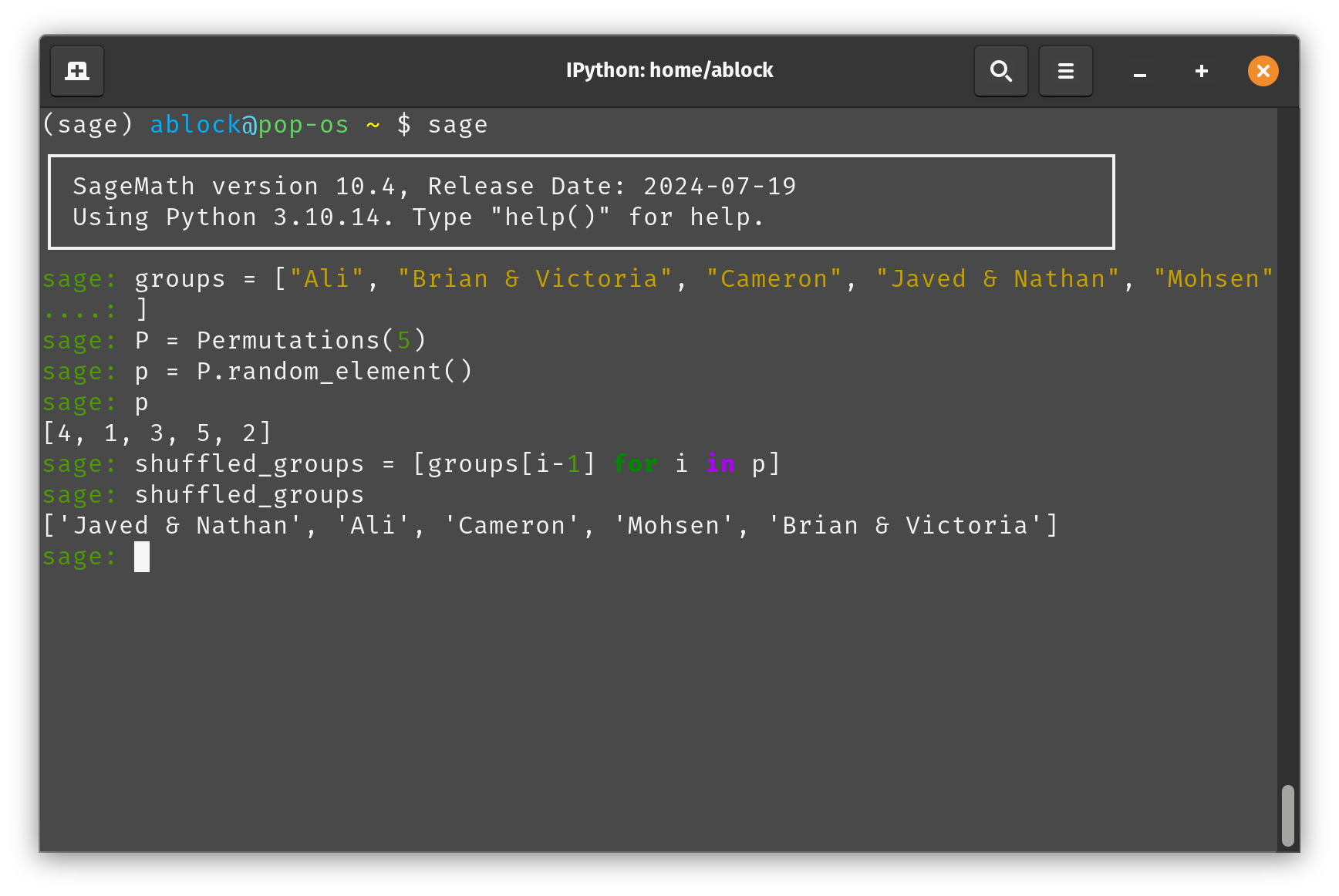
Sagemath Code used to generate this result.
groups = ["Ali", "Brian & Victoria", "Cameron", "Javed & Nathan", "Mohsen"]
P = Permutations(5) # set of all permutations on [1,2,3,4,5]
p = P.random_element() # samples a random permutation of the list [1,2,3,4,5]
p # prints the sampled permutatation
shuffled_groups = [groups[i-1] for i in p]
shuffled_groups # prints the new ordering for 'groups'
Code screenshot below.
Project Description
The project you choose can be related to your research area, or completely unrelated. You may work in teams of up to 3 people. However, whatever your project is and however many people you have on your team, the project will consist of two major components—an In-Class Presentation, and a Written Report—as well as two minor components—Project Proposals and Peer Evaluations. There are no rigid page limits for the report; anything between 4–20 pages can work. For the In-Class presentation, you are expected to give a 15–18 minute presentation using the presentation materials of your choice (e.g., PowerPoint, Keynote, , Google Slides, a Board Talk, etc.).
The project can be a survey of a problem or topic of your choice, or a novel analysis of a problem that you like. In the first case, if you read some papers and summarize them in a survey, give the reader the required background (which may be covered only briefly in some conference papers) together with the main results and their proofs and open questions. For the second scenario, if you try to solve a problem that you are interested in, explain the connections with previous work; in case you don’t arrive to a solution by the end of the term, show what approaches you tried and what didn’t work.
The goal of the project is to understand a problem as much as possible, and to give you experience with complexity theory research. Give the reader the background and necessary explanations to make the problem very clear, understand the contribution of the paper, and the approaches used. You do not have to summarize every theorem in the paper (in either write-up or presentation). Pick instead one or a couple of results in the paper(s) you are reading and focus on those, while trying to answer questions such as: What is the idea of the proof? What techniques are the authors using? Where are the difficulties? What are the remaining open questions?
Recent proceedings of good conferences that publish theoretical work are a possible starting point. Some examples are STOC/FOCS/ITCS/SODA/APPROX-RANDOM, CRYPTO/TCC, EC (Economics and Computation), COLT, PODC.
Project Timeline
-
Saturday, March 22, 2025, by 11:59pm CDT. Submit your project proposals to me. This includes at least one paragraph about your project, along with at least one (or, ideally, a few) papers you plan to read for the project. The easiest way to do this is to email me, cc your team members, and include the relevant information in the email.
-
Tuesday, April 29, 2025, and Thursday, May 1, 2025. The last week/last two classes, we will hold the in-class presentations. Attendance will be required except for special cases. Part of this project is to give you experience presenting material you may not be very familiar with or an expert in to an audience who will be even less familiar with your topic. Also, you will be giving peer evaluations to your fellow students as well, and everyone will be required to submit these peer evaluations.
-
Saturday, May 10, 2025, by 11:59pm CDT. Your written reports are due the day after finals. I want to give you as much time as possible for the written reports, but I will still need to read and grade them before grades are due. Early submissions (e.g., before finals) are also fine. You will submit your written reports via
GradescopeBlackboard.
Grade Brakedown
- (5%) Project Proposals
- (10%) Peer Evaluations
- (40%) In-Class Presentation
- (45%) Written Report