
2026-06-22 - Two Demos Accepted for VLDB 2026
Two demos accepted for VLDB 2026
We got two demonstrations accepted for VLDB 2026: one on repairing queries to fulfill aggregate constraints and another one on replacing LLMs with cheaper specialized models for repeating tasks.
The demos will be presented at VLDB in
- Demo Group C - Data Quality, Analytics & Applications
- Marina Ballrooms II–IV
- Wednesday 13:45 – 15:15 + Thursday 15:45 – 17:15
Q-ACER: Query Aggregate Constraint Efficient Repair System
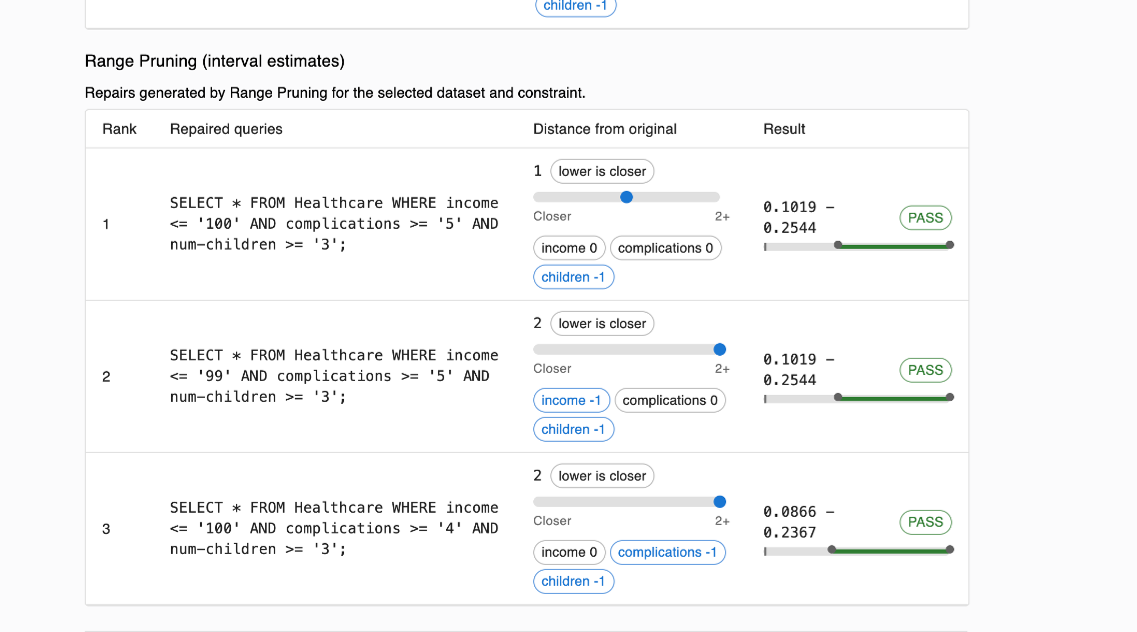
In this work [1] in collaboration with Seokki, Age, and Shatha we present a system that repairs queries to fulfill constraints over the whole result of the query by modifying selection predicates in the query. This is useful as queries are often used to select a set of suitable objects / persons from a list of candidates, e.g., which job applicant should be in- terviewed or which vendor to order a product from. These use cases have in common that the same criteria, the filter conditions of the query, have to be used to judge every candidate. For instance, interview job candidate with a GPA of at least 3.9 and Java skills. The selected set of candidates as a whole typically has to fulfill additional constraints, e.g., budget limits or other policies.
We demonstrated that such requirements can be modeled as aggregate constraints which is a general class of constraints which threshold an arithmetic combination of filter-aggregation queries over the result of a user query. In contrast to prior work, this type of constraints are not monotone necessitating techniques for reusing partial aggregation results and for evaluating a set of candidate repairs at once as we demonstrated in [2] on which this work is based on.
Exploring the Benefits of Just-in-time Model Replacement
With the rise of large language models (LLMs), organizations have access to general-purpose models through high-level APIs. Thus, many organizations now outsource simple, repetitive tasks such as sentiment classification, support ticket labeling, or churn risk identification to LLMs to save on data collection and preparation, model selection, training, and deployment. However, such tasks can often be solved equally well by much simpler models that are several orders of magnitude more cost- and resource-efficient.
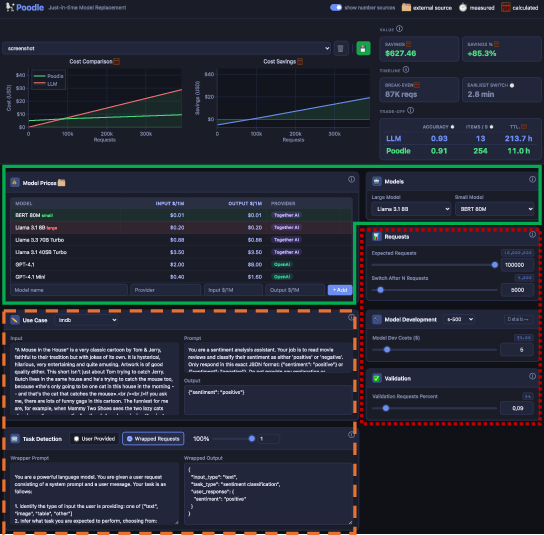
In recent work, we propose just-in-time model replacement (JITR). JITR fully automates the process of switching between an LLM and a cheaper, task-specific surrogate model, thus retaining the ease-of-use and low development cost of outsourcing tasks to an LLM while significantly reducing the inference cost of repetitive tasks. JITR is enabled by advanced model search algorithms that search a model repository to find and fine-tune an appropriate model for a task.
In [3] in collaboration with Nils and Tilmann from HPI, we present a tool for exploring the trade-offs involved in JITR. Through an interactive dashboard, users can explore cost savings from using JITRs compared to LLMs across a variety of tasks, controlling parameters such as the models used, the number of expected requests, and more.
-
Q-ACER: Query Aggregate Constraint Efficient Repair System
Vaishnavi Deshpande, Seokki Lee, Shatha Algarni, Boris Glavic and Adriane Chapman
Proceedings of the VLDB Endowment (Demonstration Track). 19, 12 (2026) , 4802–4805.details@article{DL26, author = {Deshpande, Vaishnavi and Lee, Seokki and Algarni, Shatha and Glavic, Boris and Chapman, Adriane}, title = {Q-ACER: Query Aggregate Constraint Efficient Repair System}, keywords = {Query Repair}, journal = {Proceedings of the VLDB Endowment (Demonstration Track)}, projects = {}, volume = {19}, number = {12}, pages = {4802 - 4805}, pdfurl = {https://www.vldb.org/pvldb/vol19/p4802-glavic.pdf}, doi = {10.14778/3827998.3828126}, year = {2026}, venueshort = {{PVLDB}} }
-
Exploring the Benefits of Just-in-time Model Replacement
Nils Strassenburg, Boris Glavic and Tilmann Rabl
Proceedings of the VLDB Endowment (Demonstration Track). 19, 12 (2026) , 4674–4677.details@article{SG26, author = {Strassenburg, Nils and Glavic, Boris and Rabl, Tilmann}, title = {Exploring the Benefits of Just-in-time Model Replacement}, keywords = {Sys4ML, Machine Learning, Model Search}, journal = {Proceedings of the VLDB Endowment (Demonstration Track)}, projects = {}, volume = {19}, number = {12}, pages = {4674 - 4677}, doi = {10.14778/3827998.3828094}, pdfurl = {https://www.vldb.org/pvldb/vol19/p4674-strassenburg.pdf}, year = {2026}, venueshort = {{PVLDB}} }
-
Efficient Query Repair for Aggregate Constraints
Shatha Algarni, Boris Glavic, Seokki Lee and Adriane Chapman
Proceedings of the VLDB Endowment. 19, 2 (2025) , 252–264.details@article{AG25, author = {Algarni, Shatha and Glavic, Boris and Lee, Seokki and Chapman, Adriane}, title = {Efficient Query Repair for Aggregate Constraints}, journal = {Proceedings of the VLDB Endowment}, year = {2025}, venueshort = {{PVLDB}}, volume = {19}, number = {2}, reproducibilitybatch = {available}, pages = {252 - 264}, doi = {10.14778/3773749.3773762}, pdfurl = {https://www.vldb.org/pvldb/vol19/p252-algarni.pdf}, longversionurl = {https://arxiv.org/pdf/2511.00826}, keywords = {Provenance; Fairness} }